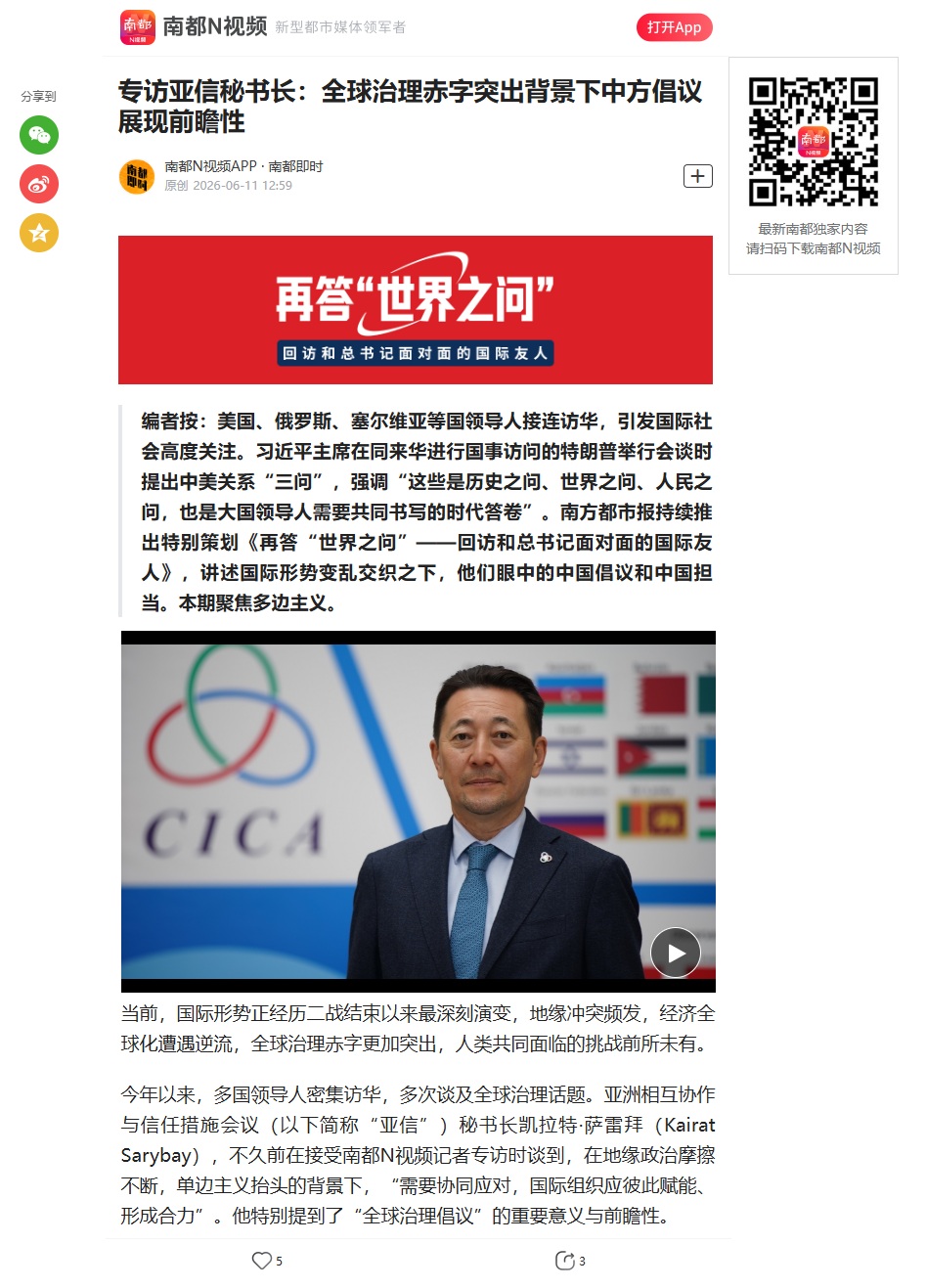
Interview with Secretary General of the Conference on Interaction and Confidence Building Measures in Asia
Ambassador Kairat Sarybay for Metropolis Daily
(English version)
1. In 2025, you participated in the Shanghai Cooperation Organization Tianjin Summit and also attended the commemoration activities for the 80th anniversary of the victory of the Chinese People’s Resistance Against Japanese Aggression and the World Anti-Fascist War in Beijing. More recently, in March 2026, you contributed to the Boao Forum for Asia. On September 1, 2025, Chinese President Xi Jinping proposed the Global Governance Initiative (GGI) at the “Shanghai Cooperation Organization Plus” Meeting in Tianjin. How do you perceive the “Global Governance Initiative”? What commonalities exist between this initiative and the principles upheld by CICA?
In recent years, the international community has been navigating an increasingly complex geopolitical environment. As 2026 unfolds against a backdrop of profound uncertainty, the need for dialogue, cooperative security, and effective multilateral engagement has never been more evident. In this context, events that reaffirm shared principles and collective responsibility become vital.
It is against this backdrop that my participation in the SCO Plus Meeting in Tianjin, alongside the commemoration of the 80th anniversary of the end of the Second World War in Beijing, carried both symbolic and substantive importance. These occasions served as timely reminders of the enduring value of unity, historical memory and multilateral cooperation in addressing contemporary challenges, while discussions in Tianjin reflected a shared interest among Asian partners in reinforcing cooperative approaches to regional stability and global governance.
It is highly significant that President Xi Jinping specifically highlighted our organization’s role in promoting multilateralism in global affairs. Such recognition at a major international forum validates CICA’s ongoing transformation as a premier pan-Asian platform for trust and cooperation. China’s proactive and sustained engagement within CICA demonstrates its dedication to inclusive regional dialogue, utilizing the organization to build consensus and advance common goals.
It was in this meaningful multilateral setting that President Xi put forward the Global Governance Initiative (GGI), which represents a constructive contribution to the ongoing international discourse on the future of global governance.
From a substantive standpoint, the principles articulated in the GGI demonstrate a strong alignment with CICA’s philosophy and operational approach. The emphasis on sovereign equality, respect for the UN Charter, genuine multilateralism, and inclusiveness closely aligns with the very foundations upon which CICA was built. Both frameworks share the understanding that peace, security, and development are deeply interconnected and can only be sustained through confidence building and collective effort in a diverse, dynamic region like Asia.
The GGI also aligns naturally with the broader set of initiatives proposed by President Xi in recent years – namely the Global Security, Development, and Civilization Initiatives – which together present an integrated and balanced vision of global governance. It is worth highlighting that the Concept Paper of the Global Security Initiative recognizes CICA as an instrument for Asian and global security, alongside other platforms and mechanisms. This holistic perspective resonates with CICA’s multidimensional approach, which advances cooperation across political, economic, environmental, humanitarian and cultural spheres.
My recent visit to China in March 2026 further reaffirmed this vision. The alignment between CICA’s mandates and China’s global initiatives reflects a unified dedication to multilateralism. This shared ground was vividly echoed at the 2026 Boao Forum for Asia, where the Forum’s 25th anniversary highlighted an Asian approach to shared prosperity that closely mirrors CICA’s core values of mutual trust.
Recognizing that current geopolitical challenges demand cohesive responses, we believe international organizations must amplify each other's efforts. To translate this collaborative spirit into concrete action, the CICA Secretariat will host a gathering of the executive structures of Asia's international organizations in Astana this June. Coinciding with the 20th Anniversary of the Secretariat, this meeting is designed to forge stronger institutional bonds and elevate our practical cooperation.
2. CICA was established slightly more than 30 years ago and has consistently been committed to promoting peace, security, and stability in Asia through multilateral dialogue and cooperation. In fact, trust and collaboration among Asian countries represent a complex yet crucial issue. What do you think mainly determines this? As a founding member of CICA, what role has China played in its development?
Looking back on more than three decades of CICA’s evolution, one lesson remains profoundly clear: trust and cooperation in Asia do not emerge automatically. Rather, they are built patiently through continuous dialogue and strict adherence to shared principles. In a region as vast and diverse as Asia – characterized by unique historical backgrounds, different political systems, and various development paths – these elements are vital.
It was precisely this understanding that led to the establishment of CICA over 30 years ago. From the very beginning, our organization was conceived as an inclusive, consensus-based platform. It was designed to bring together nations of Asia, providing a space for dialogue grounded in sovereign equality and non-confrontation. Over time, this approach has proven that genuine trust stems from predictability, inclusiveness, and sustained engagement.
Within this framework, the role of China as a founding Member State is highly significant. China has consistently viewed CICA as a practical, forward-looking mechanism for fostering dialogue, strengthening confidence, and advancing cooperative security across the continent.
China’s contributions have been evident on multiple levels. Politically, Beijing has actively supported CICA’s ongoing transformation into a full-fledged international organization, recognizing this process as a necessary evolutionary step to enhance our institutional capacity, effectiveness, and long-term sustainability. This stance strongly reflects China’s broader commitment to inclusive multilateralism and dialogue-based cooperation in the region.
Institutionally, China’s Chairmanship from 2014 to 2018 made a lasting impact on our development. This period saw the launch of the CICA Think Tank Forum, which continues to serve as an important platform for intellectual exchange. Furthermore, China helped lay the conceptual groundwork for expanding practical cooperation in the economic and financial spheres by initiating the CICA Finance Summit. Notably, in 2025, this initiative was successfully institutionalized into an advisory body to further promote financial cooperation among Member States.
In parallel, China remains one of the most consistent contributors to the work of the CICA Secretariat. Through voluntary financial contributions and the provision of qualified human resources, this sustained assistance ensures our operational stability. It empowers the Secretariat to effectively fulfill its expanding mandate in support of all Member States.
Taken together, China’s engagement with CICA can be characterized as principled, forward-looking, and deeply supportive of consensus-based cooperation. This unwavering commitment reinforces CICA’s standing as a meaningful and trusted platform for promoting peace, stability, and multilateral dialogue throughout Asia.
3. In 2022, CICA set the objective of transforming from a regional forum into an international organization. What significant implications do you believe this transformation holds for Asian countries in jointly addressing security threats and promoting development cooperation? What achievements have been made in this process thus far? Meanwhile, what difficulties are being encountered?
Since 2022, transformation of CICA has unfolded as a gradual and carefully sequenced process, reflecting the collective will of its Member States to strengthen the organization while preserving its inclusive nature. This decision emerged from a shared recognition that Asia’s evolving role in regional and global affairs requires mechanisms of cooperation that are reliable, adaptable, and capable of supporting long-term dialogue.
To be precise, the transformation process was launched at the Sixth CICA Summit in Astana with the adoption of the Astana Statement on CICA Transformation, under the Chairmanship of Kazakhstan. This political decision was taken by consensus among Member States, setting in motion a measured effort aimed at strengthening CICA’s institutional foundations. A key milestone followed in 2023 with the adoption of the CICA Transformation Road Map, which provided a consensual framework for advancing this process in a phased and inclusive manner.
Since then, tangible progress has been achieved. A particularly significant milestone was the establishment of a dedicated CICA headquarters in Astana, inaugurated in July 2025 by the President of the Republic of Kazakhstan, Kassym-Jomart Tokayev, underscoring the host country’s commitment and symbolizing growing confidence in both the future of Asian cooperation and CICA’s institutional maturity. Further steps have included the refinement of modalities for implementing Confidence Building Measures and the clarification of the international status of Secretariat personnel, aligning CICA’s operational practices more closely with established international standards.
At the same time, the transformation of CICA is understood as an evolutionary process. Its success depends on sustained dialogue, sensitivity to national perspectives and, above all, the continued ability of Member States to build consensus. Given the diversity of Asia, differences in pace, priorities and expectations are natural. Addressing them through consultation and mutual understanding is an integral part of the transformation itself.
Looking ahead, CICA’s transformation continues to advance in a gradual and inclusive manner under the current Chairmanship of Azerbaijan. Ongoing work on the draft CICA Charter, which has already undergone a first reading and reflects a growing convergence of views among Member States, is being complemented by the establishment of two new advisory bodies – the CICA Finance Summit and the CICA Women’s Council – further strengthening CICA’s institutional architecture.
In 2025, under the able stewardship of the Azerbaijani Chairmanship, CICA’s existing mechanisms demonstrated strong operational momentum. The Business Council advanced dialogue on economic cooperation and SME development, while the Think Tank Forum contributed to discussions on regional security and CICA’s transformation. The Youth Council expanded engagement through meetings, youth contests and side events promoting volunteerism and innovation. At the same time, the Partnership Network of Leading Universities continued to grow, and the CICA Fund launched its first project, underscoring CICA’s increasing capacity for practical, impact-oriented cooperation.
In this context, the CICA Summit in Baku in October 2026 will serve as an important occasion to take stock of progress and consider next steps, with the adoption of the Charter envisaged as the culmination of CICA’s institutional transformation.
Overall, the transformation of CICA holds meaningful implications for Asian countries. It is intended to enhance our organization's capacity to support joint efforts in addressing security challenges and promoting development cooperation, while fully respecting the principles of sovereign equality, consensus, and voluntary participation. This process represents more than just an institutional change, it is a vital step toward strengthening trust, predictability, and cooperation across Asia advancing the common goals of all Member States.
4. From the perspective of CICA’s focus on Asian regional development and the promotion of exchanges and cooperation among member states, what changes in China over the past five years have impressed you and are in line with the objectives of CICA? What positive impacts have these changes had on the development of the Asian region and the work of CICA?
Asia’s development over the past five years has been shaped by a combination of national reforms and cross-border initiatives that have profoundly influenced the region. From CICA’s perspective, the most impactful changes are those that strengthen regional connectivity, economic integration, and practical cooperation among states. In this context, several developments observed in China stand out as being closely aligned with our objectives.
China’s approach to international engagement emphasizes predictability, shared rules, and institutional continuity. By advancing its initiatives within the framework of the UN Charter and universally accepted norms of international law, China has made a significant contribution to the discourse on how diverse development paths can coexist within a stable multilateral order. For CICA, where trust is built through dialogue, consensus, and inclusiveness, this approach aligns perfectly with our philosophy.
Additionally, China has embraced a highly pragmatic vision of multilateralism. There is a clear recognition that multilateral frameworks need to evolve beyond being platforms for national declarations, acting instead as practical mechanisms for joint problem-solving. This mindset naturally complements our organization's ongoing transformation into a more proactive, results-oriented force for confidence building in Asia.
The rapid expansion of the Chinese economy, coupled with technological breakthroughs, has become a major driver of regional and global development, notably through Asian Infrastructure Investment Bank (AIIB) and Belt and Road Initiative (BRI).
The BRI helps meet infrastructure needs by investing in transport, energy, and digital networks. At the same time, Chinese technological advances – especially in high-speed rail, renewable energy, and digital platforms – support modernization and inclusive growth across partner economies. As corridors expand, the movement of goods and people becomes easier, highlighting the need for coordinated connectivity. This remains a focal point for us: knowing that connectivity brings economies closer, Member States have held thorough deliberations on creating an advisory body for transport connectivity.
These developments clearly show how national transformation, paired with openness, brings real benefits to the entire region. Within CICA, we value China’s experience as a helpful reference that enriches our dialogue and supports practical cooperation among Asian countries.
5. 2026 marks the beginning of China’s 15th Five-Year Plan. From the perspectives of Asian country collaboration and global governance, what valuable suggestions do you have for China’s 15th Five-Year Plan? For instance, in which areas do you think China can further strengthen cooperation with Asian countries and even the entire world during the 15th Five-Year Plan period to jointly promote world peace and development?
The launch of the 15th Five-Year Plan in 2026 comes at a time when long-term national planning is intertwined with regional and global dynamics. Across Asia, domestic development strategies increasingly shape the broader landscape of interdependence and collaboration.
In this context, several key areas of cooperation stand out for the years ahead.
First, connectivity and resilient supply chains remain central to economic stability. This includes advancing joint infrastructure projects, logistics cooperation, trade facilitation, and the creation of reliable digital corridors.
Second, sustainable development and the green transition offer immense potential. Joint initiatives in clean energy, climate resilience, water management, and green finance are highly promising and essential for the region's future.
Third, digitalization and innovation – such as digital government, secure networks, and emerging technologies – present major opportunities to address development needs and improve institutional efficiency across partner nations.
Moving forward, expanding development-oriented partnerships and cultural exchanges will further build practical confidence. These collaborative efforts support peace and development across Asia and beyond, naturally complementing CICA’s core mechanisms.
6. The ongoing conflict between the United States, Israel, and Iran has attracted intense global attention. The spillover effects of this conflict are evident – navigation through the Strait of Hormuz has been disrupted, international oil prices have surged, and the world economy is feeling the impact. Notably, both Iran and Israel are member states of CICA. Has CICA engaged in any communication or coordination with the relevant member states amid this conflict? Furthermore, facing the current tense situation, can CICA leverage its platform to issue calls and initiatives?
The current dynamics in West Asia are deeply concerning and represent a major test for the international community. Today’s world is highly interconnected, and as we can see, regional tensions carry immediate global consequences, directly affecting international security and economic resilience.
Regarding the role of our organization in addressing such acute crises, it is essential to understand that CICA, as a multilateral platform, operates strictly on the principle of consensus. In times of severe geopolitical tension, the value of inclusive platforms becomes even more critical. CICA is one of the very few forums in the world where all regional actors, including those that have differences, continue to engage as full and equal members.
We firmly believe that the presence of all parties within the same framework is an indispensable opportunity. It keeps communication channels available when they are needed most. Maintaining this inclusive space and focusing on long-term trust-building is essential for guiding the region toward lasting stability.
